
Created in 1997 by Orano and Kazatomprom in Kazakhstan, KATCO operates the world’s largest in situ uranium mine. This in situ recovery technology (ISR) makes it possible to extract low-content uranium economically and with little environmental impact.
KATCO, the world's N°1 producer of ISR uranium
• KATCO shareholders: Orano (51%) and Kazatomprom (49%) Kazakhstani national operator.
• Annual production capacity: 4,000 tons.
• Over 60,000 tons of uranium produced since 2006.
• KATCO’s production accounts for 15% of Kazakhstan’s annual uranium production and 7% of global production.
• Annual production capacity: 4,000 tons.
• Over 60,000 tons of uranium produced since 2006.
• KATCO’s production accounts for 15% of Kazakhstan’s annual uranium production and 7% of global production.
KATCO - one of the world’s leading producers of uranium by ISR Technology
Established in 1996 to mine the deposits of Muyunkum and Tortkuduk in South Kazakhstan, KATCO draws on the international experience and expertise of Orano and Kazatomprom to develop its production activities.
In 2009, the KATCO mine became the world's largest ISR mine. A total of 60,000 tonnes of uranium have been produced since production began in 2006.
In April 2017, Orano and Kazatomprom strengthened their historic cooperation. By signing
a strategic agreement in such areas as the development of the South Tortkuduk project (located close to two current fields), KATCO is perpetuating its production for the next two decades.
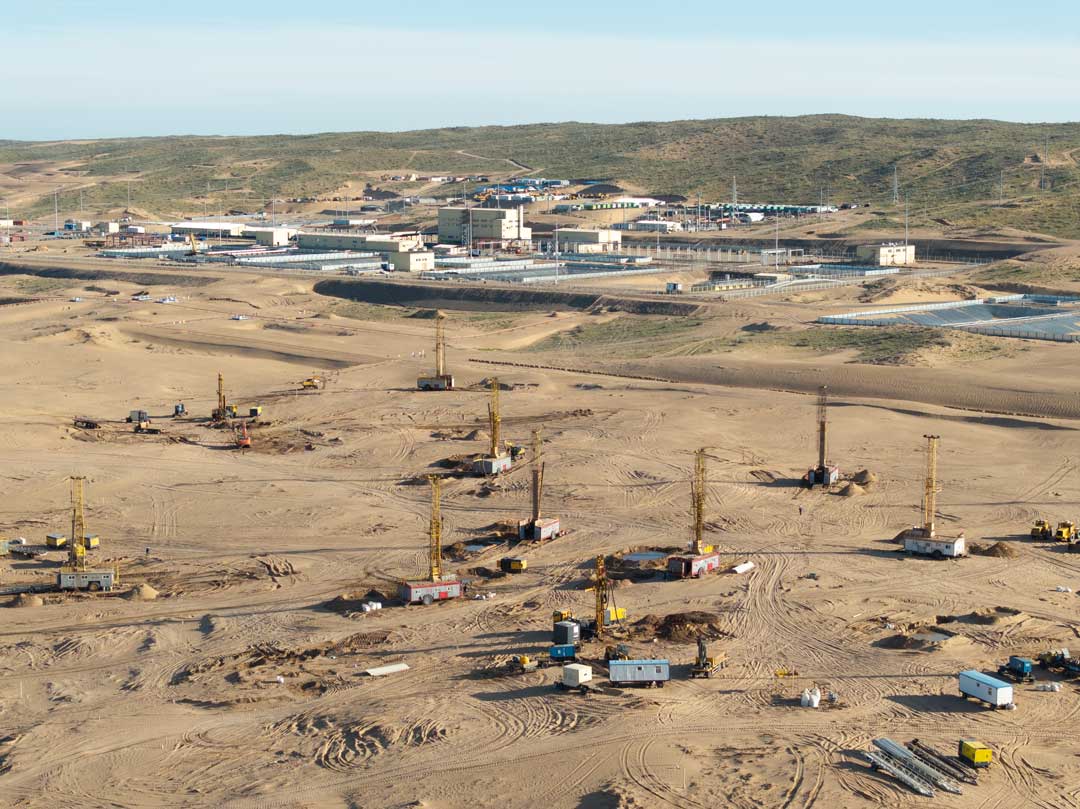
South Tortkuduk Project
Located in the south of Kazakhstan, South Tortkuduk is part of the Muyunkum uranium deposit, already mined by KATCO, with considerable reserves of 46,000 tons of uranium. This parcel was discovered and logged by KATCO geologists.The first production from South Tortkuduk commenced in June 2024, and, in July 2025, the mining company KATCO and its shareholders, Orano and NAC Kazatomprom JSC, celebrated the inauguration of the new uranium processing plant, marking the full start-up of operations on the mining site.
Its production will gradually replace production from the areas currently being mined, enabling KATCO to extend its production for more than a decade.
The South Tortkuduk project, representing a total investment of USD 190 million, has been designed in accordance with international best practices, with a focus on reducing environmental impact, in particular in terms of carbon footprint, and on improving operational performance with a view to optimizing mining operations.
A recovery method adapted to low-grade deposits
Recovering uranium without digging
The in situ recovery principle consists of injecting a leaching solution through shafts into the uranium deposit. The solution (dilute acid and water) dissolves the uranium as it passes through
the deposit and is pumped to the surface. The solution loaded with uranium is then transported by pipeline to the plant where the uranium is extracted and fixed on ion exchange resins. The solutions are enriched with acid and re-injected into the
wells, continuing the closed circuit process.
ISR technology has evolved with tight operational and regulatory controls. It causes little surface disturbance, does not generate tailings or waste rock, and requires less investment than conventional
mining. However, this technique is put into use only when the ore is located between impervious soil layers such as in Kazakhstan and Mongolia.
Nearly 50% of the world’s uranium deposits are mined using ISR techniques, according to the World Nuclear Association, WNA.